
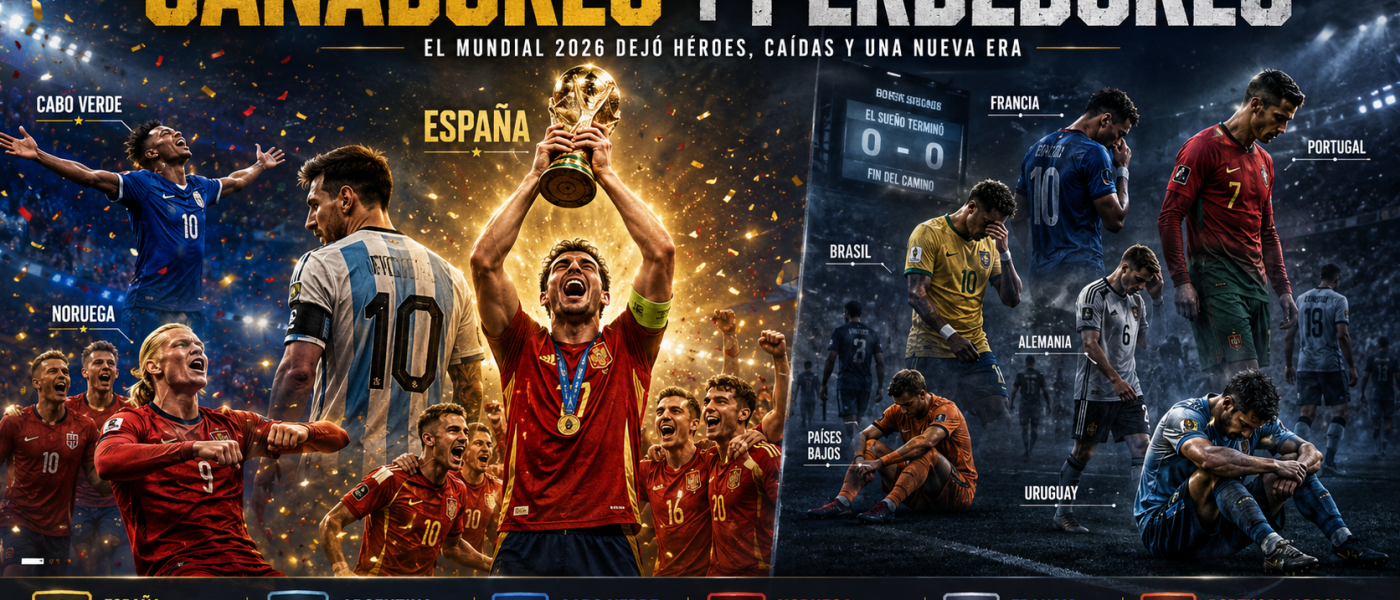
Winners and losers of the 2026 World Cup: Spain built a new era while several giants discovered their decline
Spain lifted the trophy. Argentina lost the final but extended an extraordinary era. Cape Verde produced the tournament’s most improbable story. Norway discovered that it could compete with anyone.
On the other side stood France, Portugal, Brazil, Germany, the Netherlands and Uruguay.
National teams filled with famous names, history and enormous expectations that found very different ways to fail.
The 2026 World Cup did more than produce a champion.
It changed the hierarchy of international football, confirmed a new generation of stars, destroyed several projects and exposed players who arrived with enormous club reputations but could not reproduce that influence on the biggest stage.
Spain was the tournament’s unquestionable winner.
But it was not the only one.
Argentina lost the decisive match and still left with its stature intact. Cape Verde went home without losing a single match inside 90 minutes. Norway departed knowing that one better decision might have placed it in a World Cup semifinal.
France finished fourth when its squad appeared capable of dominating the tournament. Portugal assembled perhaps the deepest group of names in its history and never looked like a genuine contender. Brazil continued searching for an identity that moves further away with every World Cup. Germany, the Netherlands and Uruguay produced campaigns far too small for their shirts.
These are the defining winners and losers of the 2026 World Cup.
Ultimate winner: Spain defeated the past and claimed the future
Spain did not win the World Cup because of a favorable bracket.
It conquered the tournament through its most demanding path.
La Roja eliminated Portugal in the round of 16. It defeated Belgium in the quarterfinal. It neutralized France in the semifinal. In the final, it beat defending champion Argentina after 120 minutes.
In its final two matches, Spain defeated the winners of the previous two World Cups.
France, champion in 2018.
Argentina, champion in 2022.
Spain did not inherit the crown.
It took it away from the teams that had owned it.
The title also completed a superiority that had defined Spain throughout the tournament. La Roja controlled matches through possession, but its authority extended far beyond the ball.
It pressed. It recovered possession far from its own goal. It defended with discipline. It found goals from different positions and built a squad with enough depth to solve every kind of match.
Lamine Yamal and Nico Williams provided the imbalance. Rodri governed the center. Fabián Ruiz and Dani Olmo connected the lines. Pedro Porro, Mikel Merino, Mikel Oyarzabal and Ferran Torres appeared in decisive moments.
In the final, with Argentina defending with ten men and threatening to take the match to penalties, Spain never abandoned its identity.
It continued moving the ball.
It continued waiting.
It continued believing.
Until Ferran Torres scored the goal of the second star.
Spain arrived as European champion. It left as world champion, undefeated and having conceded only one goal during the entire knockout stage.
This is no longer a promising generation.
It is a world champion generation.
Why Spain is the tournament’s biggest winner
- It won the second World Cup in the country’s history.
- It defeated the world champions of 2018 and 2022.
- It eliminated Portugal, Belgium, France and Argentina.
- It won without depending on one attacking star.
- It proved that the European Championship title was not an isolated achievement.
- It finished as the best team in both performance and results.
Loser: France had an extraordinary squad and finished completely empty
France entered the World Cup with a squad that appeared stronger than the team that won in Russia in 2018 and deeper than the side that reached the final in Qatar in 2022.
It had experience. It had depth. It had elite players in their prime. It had Kylian Mbappé playing the tournament that could establish him as the unquestioned owner of the new era.
It also had motivation.
The defeat against Argentina in Qatar was still present. France did not need to learn how to compete at a World Cup. Its structure had already reached two consecutive finals and was seeking a third.
For much of the tournament, it appeared capable of doing exactly that.
Then Spain dismantled it in the semifinal.
This was not a heroic elimination or a defeat decided by one unfortunate detail. La Roja controlled the match, reduced Mbappé’s influence, removed the space from the French attack and won 2-0 without allowing France to produce a convincing response.
Didier Deschamps’ team entered the third-place match without emotional energy, defensive order or any ability to protect itself.
England scored four times during the first half.
France reacted and scored four of its own, but ultimately conceded six in the most chaotic match of the tournament.
The 6-4 defeat summarized the end of the cycle.
There was still enough talent to attack after everything had been lost. The structure that had allowed France to survive almost every possible scenario was gone.
Deschamps leaves after building one of the greatest eras in French football history.
But he exits through a smaller door than the quality of this team appeared to promise.
With this squad, fourth place cannot be considered an acceptable campaign.
The French contradiction
France produced the tournament’s top scorer and the leading goalscorer in World Cup history.
It still failed to reach the final.
Mbappé scored ten times, but France lost its final two matches and conceded eight goals between the semifinal and third-place playoff.
The problem was never a lack of stars.
It was the failure to transform that abundance into a dominant team when the World Cup reached its decisive days.
Winner: Argentina proved that losing a final does not always mean failure
Argentina was completely neutralized by Spain in the final.
The European champion controlled possession, occupied the territory and kept Lionel Messi away from the areas where he could decide the game. Argentina resisted but rarely managed to impose the match it needed.
Its physical resources finally ran out.
Reducing Argentina’s World Cup to that final night, however, would mean misunderstanding the entire campaign.
The defending champion went much further than the physical condition of several key players appeared to allow.
Argentina retained much of the squad that had won in Qatar. Four additional years weighed heavily on players who had already survived long seasons, injuries and an enormous accumulation of matches.
The speed was no longer the same. The intensity was not the same. Several crucial players could still deliver important moments, but could no longer sustain the rhythm they had produced throughout 2022.
Argentina replaced some of that lost energy with something it has never lacked.
Heart. Pride. Personality. Resistance.
It needed extra time to eliminate Cape Verde. It fell two goals behind against Egypt and recovered. Switzerland forced another exhausting night. England stood only minutes away from eliminating the defending champion before Enzo Fernández and Lautaro Martínez changed the semifinal.
Again and again, Argentina found an answer after the match appeared finished.
That carried the team into the seventh World Cup final in its history.
Then Spain appeared.
La Roja produced a brilliant tactical plan, controlled Messi, dominated midfield and forced Argentina to chase possession for too long. Enzo Fernández’s dismissal turned extra time into an almost impossible mission.
Argentina survived until the 106th minute.
Ferran Torres ended the dream.
Argentina lost the trophy, but not the dimension of its era.
It reached two consecutive finals, won one of them and came within 14 minutes of taking the second to penalties despite the physical decline of its generation.
Spain ended its reign.
It did not end its greatness.
Why Argentina also belongs among the winners
- It reached the seventh World Cup final in its history.
- It played consecutive finals for the first time since 1986 and 1990.
- It repeatedly survived matches that appeared lost.
- It compensated for physical limitations with character and competitive intelligence.
- It proved that the era built before Qatar did not depend on one perfect tournament.
Loser: Portugal assembled the best squad in its history and never looked like a contender
Portugal arrived with enough talent to dream of everything.
Its midfield included players who control matches every week for some of Europe’s strongest clubs.
Bruno Fernandes. Bernardo Silva. Vitinha. João Neves.
Players capable of controlling possession, competing under pressure, accelerating the game, slowing it down and breaking defensive lines.
Around them stood defensive quality, attacking depth and the historic presence of Cristiano Ronaldo.
Portugal appeared to have more alternatives than at any previous point in its history.
It showed almost none of them.
The team never looked stable. It never looked ruthless. It never produced the feeling of a national side prepared to control the tournament.
Portugal advanced but never improved.
It reached the round of 16 and lost 1-0 to Spain after a late goal from Mikel Merino.
Losing to the eventual champion provides an easy explanation.
It is not enough.
Portugal did not leave only because it encountered Spain. It left because throughout the World Cup it remained less than the sum of its famous names.
Its midfield was supposed to govern the tournament.
It barely passed through it.
Winner: Cape Verde became the story that made the impossible feel normal
Cape Verde was the great story of the World Cup.
It was playing in the tournament for the first time. It represented a nation of little more than half a million people. It arrived surrounded by curiosity but with almost no expectation of competing against the strongest teams.
It finished undefeated inside 90 minutes in every match.
Cape Verde drew 0-0 with Spain, the future world champion.
It did not survive by defending desperately for a few minutes. It maintained its resistance throughout the match and showed that it could compete against one of the best national teams in the world.
It later advanced to the round of 32 and faced Argentina.
The defending champion took the lead twice.
Cape Verde answered twice.
Argentina required extra time and a move initiated by Messi to win 3-2.
Cape Verde was eliminated.
But it departed without losing a match during regulation time and after pushing both finalists to their limits.
It drew with the champion.
It forced the runner-up into extra time.
No table can completely explain the scale of that campaign.
Cape Verde did not win the trophy.
It won a permanent place in World Cup memory.
Losers: Uruguay, Germany, the Netherlands and Brazil
Four historic shirts.
Four national teams that finished far below what they once represented.
Uruguay: Bielsa, exhaustion and a style of management that failed again at a World Cup
Uruguay was eliminated during the group stage.
For a two-time champion with players in major leagues and a generation capable of competing, the result was unacceptable.
Marcelo Bielsa again exposed the limitations of a managerial approach built around constant intensity and absolute commitment to one idea.
That model can produce brilliant matches, but a World Cup punishes rigidity, exhaustion and an inability to adjust quickly.
Uruguay also paid for trusting certain players because of their past when their present form did not justify that confidence.
The team did not need to abandon its aggression.
It needed to manage it.
It could not.
The result was a national team that looked hurried, vulnerable and eliminated before the decisive phase.
Germany: one large victory created a false illusion
Germany opened the tournament with a convincing win.
The result created optimism, although the quality of the opponent demanded caution.
Once the tournament began demanding real answers, Germany could not provide them.
Paraguay eliminated the four-time champion in the round of 32 after a 1-1 draw and a penalty shootout.
The defeat was not only early.
It was empty.
Germany left without showing a convincing identity, without imposing its history and without offering evidence that it is close to recovering its former authority.
The shirt still carries weight.
The team no longer does.
The Netherlands: a campaign without light, personality or a lasting image
The Netherlands reached the knockout stage without producing excitement or fear.
There were no great performances. There was no spectacular collapse either.
There was something worse.
Irrelevance.
Morocco eliminated the Dutch on penalties after a 1-1 draw. The Netherlands left the World Cup without one performance worth remembering and without showing the ambition historically associated with its football.
No brilliance.
No dramatic failure.
Only disappointment.
Brazil: another World Cup searching for a style it no longer recognizes
Brazil continues to search for a road back toward itself.
The problem is not only that it has failed to win the World Cup since 2002.
The deeper problem is that every tournament appears to move Brazil further away from the identity that made it the most important national team in football history.
Norway eliminated Brazil 2-1 in the round of 16.
Neymar scored and extended his individual story, but Brazil could not control Haaland or transform its attacking talent into a dominant performance.
Vinícius Júnior attempted to accept responsibility. He could not carry the national team. Raphinha failed to influence the tournament before an injury ended his participation.
Brazil continues searching for jogo bonito as though it were an old image that could return simply by being mentioned.
Football does not work that way.
The style that delivered five World Cups required talent, but also courage, automatic combinations, decisive fullbacks, midfielders capable of controlling the game and forwards who believed every match belonged to them.
This Brazil had famous names.
It did not have that certainty.
Winner: Norway stopped being only Haaland’s national team
Norway played its first World Cup with this generation and reached the quarterfinals.
The result was already historic.
The way it achieved that result made the campaign even more important.
Norway defeated Ivory Coast and then beat Brazil 2-1 in a performance that confirmed Erling Haaland could transfer his goalscoring power to the World Cup.
Against England, Norway stood one better decision away from changing its destiny.
It had opportunities to extend the lead, finish a move or manage the match differently. England survived, responded and won 2-1.
Norway came close to reaching a semifinal.
Not through chance.
Through genuine competitiveness.
Haaland was its main weapon, but the tournament also revealed an organized and physically strong national team prepared to support him.
Norway also produced the most memorable celebration of the tournament.
The “Viking Row,” with its players becoming imaginary rowers in front of the supporters, became one of the World Cup’s defining images.
Norway arrived as an interesting story.
It left as a team nobody will underestimate again.
Individual winners: Messi, Mbappé and Haaland confirmed their place among football’s elite
World Cups often separate reputation from genuine greatness.
Lionel Messi, Kylian Mbappé and Erling Haaland ended the tournament in very different positions.
All three proved they belong at the highest level.
Lionel Messi: at 39, he produced another extraordinary World Cup
Messi arrived as a champion with no debt left to pay.
He still placed himself at the center of the tournament.
He scored, assisted and led an Argentina side that repeatedly needed his intervention during its most extreme moments.
At 39, he produced a statistically stronger tournament than the one he had played in Qatar.
He no longer possessed the same physical energy, but compensated with vision, precision and an undiminished ability to change matches.
He did not score against England, but participated in both goals that carried Argentina into the final.
Spain successfully neutralized him during the decisive match.
That does not diminish his tournament.
Messi played in his third World Cup final and brought Argentina within 14 minutes of a possible penalty shootout for consecutive titles.
His final image was not of lifting the trophy.
His World Cup still matched the scale of his career.
Kylian Mbappé: the greatest World Cup player of his generation
France was one of the tournament’s major losers.
Mbappé was not.
He scored ten goals in eight matches and won the Golden Boot again.
His two goals against England increased his career World Cup total to 22.
No player has scored more.
He achieved it in only three tournaments: four goals in 2018, eight in 2022 and ten in 2026.
Mbappé is already a champion, a finalist and the leading goalscorer in World Cup history before turning 28.
France failed to match his level during the final matches.
He again proved that the World Cup is his natural stage.
Erling Haaland: the goalscoring machine arrived at the World Cup
Haaland entered without previous World Cup experience.
He did not require an adaptation period.
He scored eight times and played a decisive role in carrying Norway into the quarterfinals.
His two goals against Brazil produced one of the knockout stage’s greatest shocks. His power changed the way every opponent defended and transformed Norway into a permanent threat.
He could not complete the story against England.
But he finished his first World Cup among the tournament’s top scorers and with the certainty that more opportunities will come.
Messi represented history.
Mbappé confirmed the present.
Haaland announced that he also intends to dominate the future.
Special mention: Cristiano Ronaldo and the record that survived an ordinary World Cup
Cristiano Ronaldo’s World Cup career never reached the scale of his achievements in club football.
He won trophies, destroyed records and became one of the most important players of all time.
At the World Cup, however, he never produced the team campaign or individual performance required to place him among the competition’s defining protagonists.
In 2026, he had little influence. He showed few flashes of the player he once was, and Portugal could not transform his presence into something decisive during its most important matches.
He still left one historic statistic.
Cristiano scored and became the first footballer to find the net in six different World Cups.
He scored in 2006, 2010, 2014, 2018, 2022 and 2026.
The record does not change the evaluation of his tournament.
It does provide one final World Cup inscription for an icon who never dominated this competition in the way he dominated almost every other stage.
Individual losers: club stars who disappeared with their national teams
Vinícius Júnior and Raphinha
Brazil needed Vinícius Júnior to take control of the team.
He tried.
He could not.
His pace created occasional danger and his talent never completely disappeared, but he could not transform matches the way he regularly does for Real Madrid.
Brazil required an attacking leader capable of taking the ball and changing the team’s collective fate.
Vinícius never reached that level.
Raphinha arrived after a strong club season but never found continuity or influence. His World Cup ended completely when injury removed him from the tournament.
Together, they were supposed to provide goals, imbalance and personality.
Brazil was eliminated before either truly accepted control of the competition.
Bruno Fernandes, Bernardo Silva, João Neves and Vitinha
Portugal’s midfield appeared to be one of the most exciting units at the World Cup.
It became one of the tournament’s greatest wastes.
Bruno Fernandes was supposed to provide goals, final passes and movement into the area. Bernardo Silva was expected to offer control and combinations. Vitinha had to manage the tempo. João Neves was there to deliver energy and recover possession.
At club level, each player dominates a different part of the game.
With Portugal, those parts never became a superior team.
The midfield expected to control the World Cup had almost no decisive influence.
It did not impose conditions. It could not sustain attacks. It failed to accelerate at the right moment or protect the team when it needed rest.
Spain eliminated them.
But Portugal had begun losing long before the decisive goal.
The definitive winners and losers table from the 2026 World Cup
| Category | Team or player | Final assessment |
|---|---|---|
| Ultimate winner | Spain | Champion, second star and victories over France and Argentina |
| Winner | Argentina | Exceeded its physical limits and reached a seventh World Cup final |
| Winner | Cape Verde | Historic debut, draw with Spain and extra time against Argentina |
| Winner | Norway | First quarterfinal, victory over Brazil and eight goals from Haaland |
| Individual winners | Messi, Mbappé and Haaland | Confirmed their status among the game’s elite |
| Loser | France | Outstanding squad, fourth place and a disappointing end to the Deschamps era |
| Loser | Portugal | Famous names without authority, identity or a credible title challenge |
| Losers | Brazil, Germany, the Netherlands and Uruguay | Campaigns far below their history and potential |
| Individual losers | Vinícius, Raphinha and Portugal’s midfield | Failed to reproduce their club influence at the World Cup |
| Historic mention | Cristiano Ronaldo | First player to score in six different World Cups |
The World Cup changed hands and entered a new era
Spain lifted the trophy and opened a new chapter.
The generation of Rodri, Yamal, Williams and their teammates has stopped promising. It now rules.
Argentina lost the title but confirmed that its greatness did not depend on repeating Qatar perfectly. It travelled as far as its legs could carry it and then moved even further through the character of a national team that had learned how to survive.
Cape Verde proved that a small football nation can stand at the center of the largest tournament.
Norway discovered that Haaland can become the beginning of something collective rather than remaining an isolated star.
France learned that even the strongest squad does not guarantee a final.
Portugal confirmed that gathering stars is not the same as constructing a contender.
Brazil, Germany, the Netherlands and Uruguay received warnings they can no longer dismiss as accidents.
Messi challenged time again.
Mbappé became the leading goalscorer in World Cup history.
Haaland announced his arrival.
Cristiano left one final record.
The 2026 World Cup ended with Spain lifting its second star.
But the true scale of the tournament can also be measured through everything it left behind.
An unquestionable champion.
An exhausted and enormous runner-up.
New countries capable of dreaming.
Old powers forced to rebuild.
Stars confirmed.
Icons beginning to say goodbye.
Spain won the world.
Everyone else discovered the place they will occupy in what comes next.