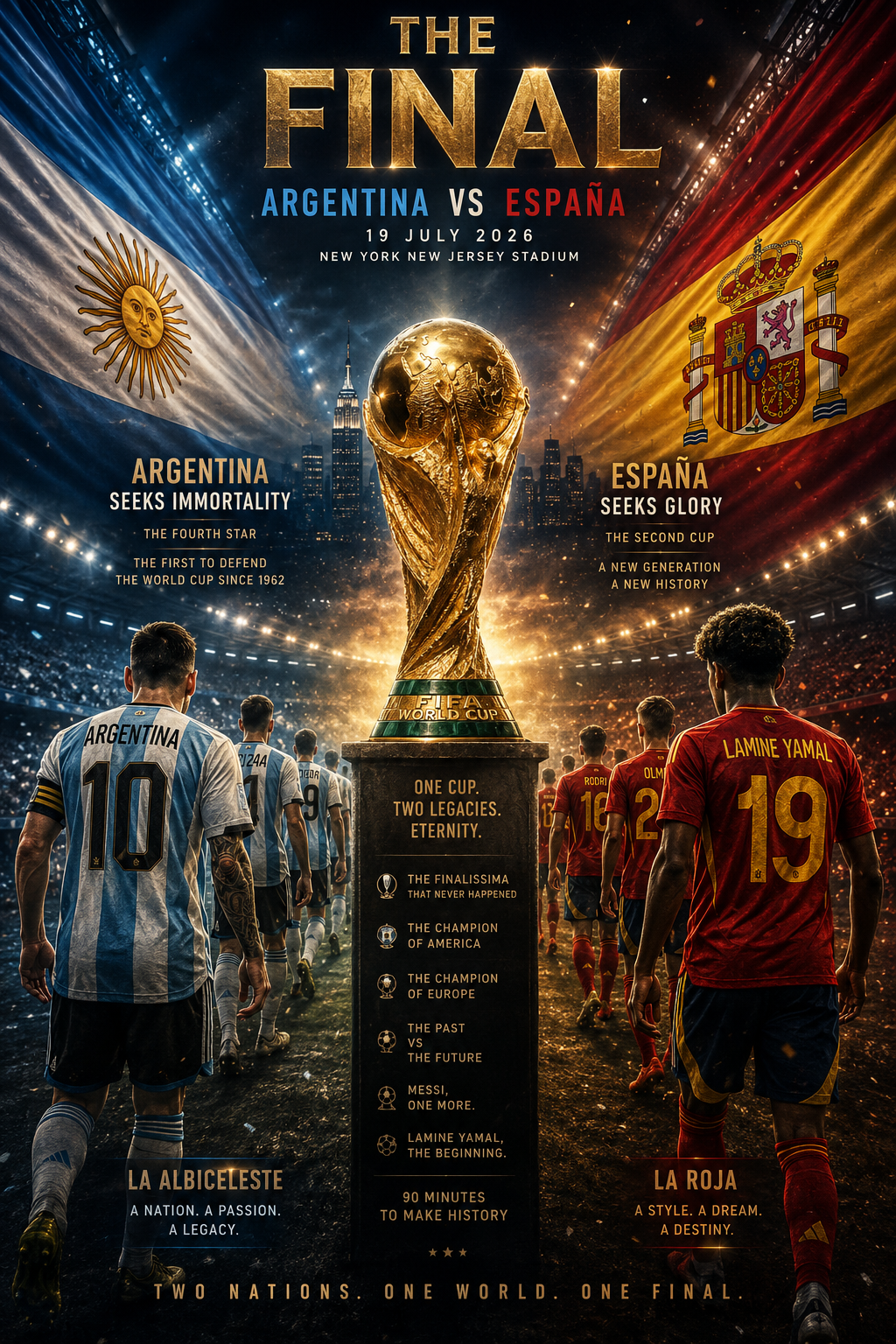
Football owed us one match.
Argentina, champion of South America. Spain, champion of Europe. Two national teams built to meet, two identities destined to collide and a Finalissima discussed for months that never reached the field.
The calendar could not hold it. The institutions could not make it happen. The date disappeared.
Then the World Cup intervened.
There will be no Finalissima.
There will be something far greater.
Argentina and Spain will play the 2026 World Cup final.
The world champion against the European champion. Lionel Messi against Lamine Yamal. The team that refuses to die against the team that appears capable of controlling everything. Three stars against one. Argentina pursuing a fourth crown, Spain trying to rule the world again for the first time since 2010.
This is not the match that was postponed.
This is the match history decided to elevate.
The Finalissima became the biggest final possible
Argentina won the Copa América. Spain conquered the European Championship. Their meeting was supposed to determine another Finalissima.
It never happened.
For months, Argentina and Spain moved along parallel roads. They carried continental titles, enormous expectations and generations ready to face each other, yet the encounter remained unresolved.
It is unresolved no longer.
On July 19, in the final game of the largest World Cup ever staged, the champions of South America and Europe will settle the debt with the most important trophy in football standing between them.
The Finalissima offered a title.
This final offers eternity.
Spain reached the final playing as though it had discovered the future
Spain did not reach the championship match by waiting for opponents to collapse.
It imposed an idea.
La Roja defeated Austria 3-0, beat Portugal 1-0, overcame Belgium 2-1 and controlled France 2-0 in the semifinal.
Its run left one powerful impression: Spain knows exactly which match it wants to play and possesses the players required to force the opponent into it.
Rodri controls the center. Fabián Ruiz connects the lines. Dani Olmo appears where defensive references disappear. Pedro Porro and Marc Cucurella stretch the field. Mikel Merino has become an answer for the moments when the match reaches its limit.
And on the edge of everything stands Lamine Yamal.
Spain has a young star who plays without asking permission. He receives, attacks and forces experienced defenders to retreat. The size of the stage does not appear to affect him. The World Cup did not make him smaller.
It made him grow.
France entered the semifinal as the favorite. Spain removed its possession, its space and eventually its hope.
Spain did not survive France.
It outplayed France.
That performance changed the meaning of the final. Spain is no longer merely a brilliant project or a team moving toward something greater.
It is already complete enough to become champion.
Spain seeks a second World Cup and the confirmation of a new era
Spain has been world champion once.
In 2010, an extraordinary generation transformed possession into authority. Casillas, Xavi, Iniesta, Busquets, Puyol, Villa and Ramos built a team capable of making the world play at its rhythm.
Sixteen years later, another Spain has reached the final.
This is not a copy of that side. It does not need to be.
The current team runs more, presses higher and attacks with greater speed. It retains the obsession with the ball, but it does not depend only on possession. It accelerates, attacks space and finds decisive players from the bench.
Victory would make Spain a two-time world champion and connect two generations separated by almost two decades.
Iniesta’s generation opened the door.
Yamal’s generation wants to walk through it.
Argentina arrives from the place where impossible stories are born
Argentina did not travel a clean road.
It traveled an Argentine road.
It needed extra time to eliminate Cape Verde. It fell 2-0 behind against Egypt and won 3-2. Switzerland pushed it into another long night. England was five minutes away from taking away its place in the final.
Argentina continued.
Against England, the defending champion trailed 1-0. Jordan Pickford stopped every attack. The clock moved toward the end and the crown appeared to be slipping away.
Enzo Fernández equalized in the 85th minute. Lautaro Martínez appeared in stoppage time. Messi participated in both goals.
Within a few minutes, Argentina moved from the edge of elimination into another World Cup final.
It was not luck.
It was not an accident.
It was the most extreme expression of a team that has learned to feel comfortable when everything appears finished.
Argentina is not playing only to win another trophy
Spain seeks its second World Cup.
Argentina seeks something more difficult to explain.
It seeks the fourth star. It seeks to defend the crown. It seeks entry into the territory reserved for national teams capable of dominating an era.
No world champion has successfully defended the title since Brazil in 1962.
For more than six decades, every team that lifted the trophy returned four years later and eventually surrendered it.
Argentina has the opportunity to break that sequence.
Defeating Spain would make this team more than the champion of 2022 and 2026. It would place Argentina among the sides that stopped belonging to a single tournament and began defining an age.
Some teams win.
Some countries celebrate.
And some national teams cross a line until they become greater than their players, their shirts and their results.
Argentina stands in front of that line.
Messi, one more
Lionel Messi is 39 years old.
He will play the third World Cup final of his career.
He lost in 2014. He won in 2022. Now he will play another.
For years, the World Cup was the absence surrounding his legacy. The trophy that seemed to follow him. The question that returned after every season, every goal and every title.
In Qatar, he answered it.
In 2026, he decided not to stop.
He entered this tournament as a champion, not as a player trying to complete his story. Yet he placed himself at the center again. He scored, assisted, led and appeared whenever Argentina needed the match to change direction.
Now there is one more.
One more final.
One more night.
Ninety more minutes to pursue something that appeared absurd even after Qatar: lifting another World Cup.
Messi no longer plays to prove he belongs in history.
He plays to decide how much of it will belong to him.
Messi against Lamine Yamal: two eras of football facing each other
The central image of the final appears written for cinema.
Messi, at 39, playing his third World Cup final.
Lamine Yamal, the face of a new Spain, playing the match that could define the beginning of his own era.
One represents a story refusing to end.
The other represents a story only beginning.
But describing the final as a simple passing of the torch would be unfair.
Messi still decides the present.
Yamal does not need to wait for the future.
Both arrive to win now.
Can Spain take the match away from Argentina?
Spain will try to control the final through possession.
It will attempt to move Argentina’s midfield, pull Messi away from the penalty area and force the defending champion to spend long stretches without the ball. Its counterpress after each turnover will be essential to preventing Argentine transitions.
Rodri and Fabián will try to establish the game in Spanish territory. Olmo will search for space behind Argentina’s midfield line. Yamal will attack every one-on-one situation. The fullbacks will provide width to a possession structure designed to exhaust and disorganize.
The major question is how much risk Spain will accept.
La Roja needs to push players forward to dominate. Argentina needs only one recovery to find Messi, Julián Álvarez or Lautaro Martínez attacking a retreating defense.
Spain could have more of the ball.
That does not guarantee control of the emotional landscape.
Does Argentina have enough left for one final battle?
Argentina has endured a physically brutal tournament.
It played extra time. It came back from deficits. It survived broken matches. It reached the limit against England and required one final explosion to reach the final.
Spain, by contrast, controlled its semifinal against France and managed its energy more effectively.
The question is unavoidable: does Argentina have anything left?
The answer will not exist only in the legs.
It will exist in the bench, in Lionel Scaloni’s management and in the team’s ability to decide when to press and when to resist. Argentina cannot chase Spanish possession for 90 minutes without consequences. It must choose its moments.
But this team has spent the entire World Cup answering similar questions.
Did it have anything left against Egypt?
Did it have anything left in extra time?
Did it have anything left when England led with five minutes remaining?
Something more always appeared.
The midfield battle could decide the World Cup
Spain will try to create superiority around Rodri. Argentina will need Enzo Fernández, Alexis Mac Allister and Rodrigo De Paul to reduce his time and space.
If Rodri receives freely and controls the rhythm, Spain will establish itself near Argentina’s penalty area.
If Argentina disrupts him, recovers possession and attacks quickly, the final changes.
Enzo arrives after scoring one of the most important goals of the tournament. Mac Allister offers intelligence and late movement into the area. De Paul represents the emotional energy of a team that turns every duel into a statement.
Recovering possession will not be enough.
Argentina must keep it.
Every short possession could return control to Spain. Every secure pass could give rest to a team that has spent almost everything reaching this point.
Scaloni faces a Spain that forces every detail to be reconsidered
Lionel Scaloni built his era around one decisive virtue: he does not fall in love with a single system.
Argentina can play with four defenders, reinforce midfield, add another center back or finish a match with several forwards.
Against England, Scaloni removed defensive players, added attackers and received the winning goal from Lautaro.
Against Spain, he will need another perfect reading.
He must decide how to defend Yamal, how far the fullbacks should advance and whether Messi should be accompanied by Julián, Lautaro or both during part of the match.
Spain offers few safe areas. It presses well, occupies the full width and punishes turnovers.
Argentina offers something no tactical board fully represents: the ability to change a match when the plan stops working.
Two opposite roads toward the same final
| Round | Spain | Argentina |
|---|---|---|
| Round of 32 | Spain 3-0 Austria | Argentina 3-2 Cape Verde, after extra time |
| Round of 16 | Spain 1-0 Portugal | Argentina 3-2 Egypt |
| Quarterfinal | Spain 2-1 Belgium | Argentina 3-1 Switzerland, after extra time |
| Semifinal | Spain 2-0 France | Argentina 2-1 England |
Spain arrives through control.
Argentina arrives through resistance.
Spain constructed its victories.
Argentina pulled them from places where they appeared lost.
One believes the match can be organized.
The other knows it can also be won inside chaos.
Spain wants to write a new history
For Spain, this final is the opportunity to transform a great generation into a world champion generation.
Winning the European Championship confirmed its return. Reaching the World Cup final confirmed its scale. Lifting the trophy would place the team in another category.
A second title would permanently change Spain’s World Cup history.
It would stop being the country of one unrepeatable generation and become a power capable of rebuilding, renewing itself and returning to the summit.
Spain is not arriving to participate in Messi’s final night.
It is arriving to destroy it.
Argentina wants to become more than champion
Argentina has already won.
It won the Copa América. It won the 2022 Finalissima. It won the World Cup. It won another Copa América. It reached another World Cup final.
But there is a difference between collecting trophies and creating an era.
The final against Spain defines that difference.
Victory would place this Argentina beside the teams whose influence cannot be reduced to one trophy.
It would be consecutive world champion. It would carry four stars. It would have survived the gradual aging of a generation, the passage of time and the pressure of defending everything already conquered.
It would be more than a team.
More than a national side.
More than a country celebrating a result.
It would become an epic passed from parents to children, from one shirt to another, from Maradona to Messi and from Messi toward everyone who follows.
The final containing every final
This final contains the Finalissima that never happened.
It contains the champion of South America against the champion of Europe.
It contains the world champion facing the team that produced the strongest semifinal performance.
It contains Messi seeking one final eternity.
It contains Yamal trying to begin his own.
It contains Spain pursuing its second star.
It contains Argentina standing before a place almost no national team has reached.
It contains exhaustion, talent, youth, memory, fear and one trophy waiting at the center of the stadium.
It does not require exaggeration.
Everything at stake is already too large.
Argentina vs Spain: 2026 World Cup final details
| Match | Date | Venue | What each team seeks |
|---|---|---|---|
| Spain vs Argentina | July 19, 2026 | New York New Jersey Stadium | Spain seeks its second title. Argentina seeks its fourth and consecutive championships |
The defining questions of the final
- Can Spain impose its possession against the defending world champion?
- Does Argentina have the energy for one final battle?
- Will Rodri control the center of the field?
- Can Argentina find Messi between Spain’s lines?
- Will Lamine Yamal be the player who ends Argentina’s reign?
- Will Lautaro Martínez decide another match from the bench or as a starter?
- Will Spain win its second star?
- Can Argentina become the first back-to-back world champion since Brazil in 1962?
- Will this be Messi’s final World Cup match?
One trophy, two champions and one night to enter eternity
When the ball begins to move, the cancelled Finalissima will stop mattering.
The postponed encounter will have found a stage too large for any previous debt.
Spain will have possession, youth and the conviction that it has played the best football of the tournament.
Argentina will have the crown, its resistance and one certainty built over years: while time remains, another story remains possible.
Spain will try to begin an era.
Argentina will try to make its own immortal.
Lamine Yamal will look forward.
Messi will seek one more.
One more to lift the trophy.
One more to defend the world.
One more so this Argentina stops being remembered only as a great national team and enters the territory reserved for sides that become legend.
On Sunday, Argentina and Spain will not play alone.
The present and the future will play. Youth and memory. Control and resistance. The champion of Europe and the champion of the world.
Two countries will enter the field.
What they play for will be greater than both.
The trophy waits.
History waits with it.
And Messi, once again, will walk toward them.