
2026 World Cup Round of 32 Final Recap: Argentina Survives Cape Verde, Egypt Makes History and Colombia Holds Firm
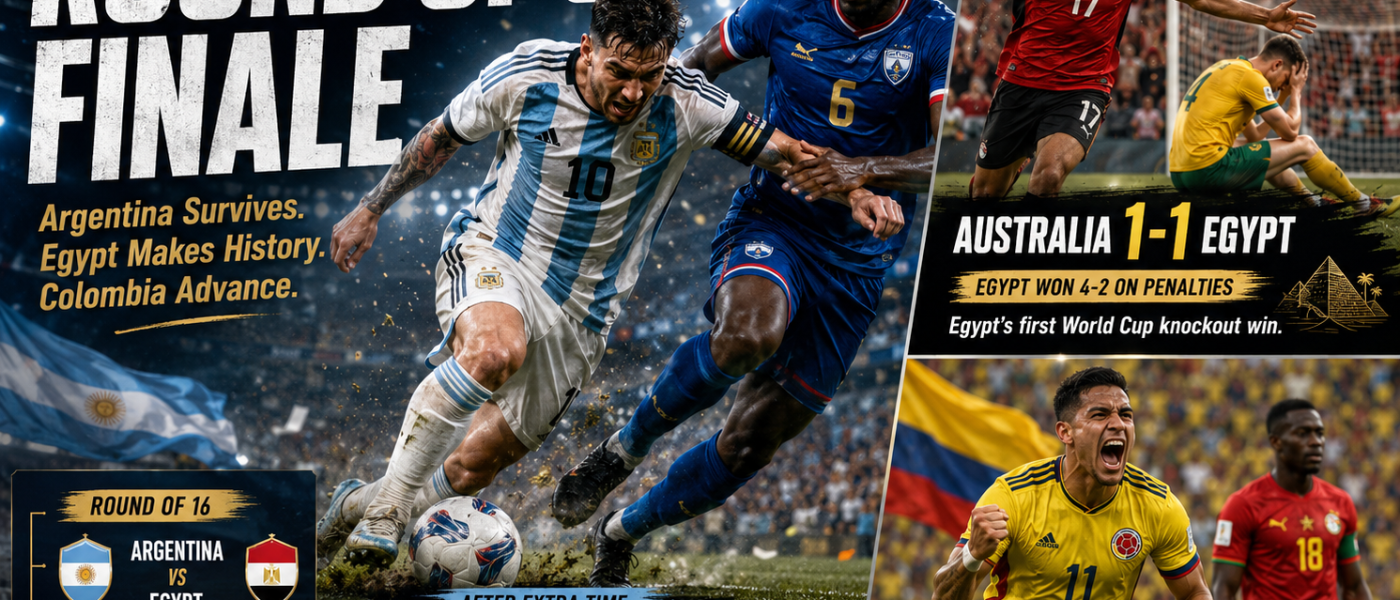
The 2026 World Cup Round of 32 ended with everything this expanded tournament promised: a champion pushed to the edge, an African giant making history, an underdog leaving with global respect, and a Colombian side advancing through control rather than noise. Argentina beat Cape Verde 3-2 after extra time, Egypt eliminated Australia on penalties, and Colombia defeated Ghana 1-0 to complete the last pieces of the Round of 16 bracket.
This was not a quiet closing day. It was a final wave of tension. Cape Verde nearly produced one of the greatest shocks in World Cup history. Egypt won its first knockout match on the biggest stage. Colombia handled a dangerous Ghana side with maturity. Australia left through the cruelty of penalties. Ghana left after failing to turn resistance into danger.
The Round of 32 started with Germany and the Netherlands falling. It ended with Argentina gasping for air, Egypt celebrating a breakthrough, and Colombia proving again that calm matters in knockout football.
The Main Story: Argentina Advanced, But Cape Verde Won the World’s Respect
Argentina is still alive. That is the headline.
But Cape Verde became the story.
The defending champions needed extra time to beat one of the tournament’s great surprise teams. The final score was Argentina 3-2 Cape Verde, but the emotional score was much closer. Cape Verde twice came back against the world champions and dragged the match into the kind of space where favorites start to feel the weight of history.
Argentina had Messi, experience and elite defenders. Cape Verde had courage, organization and a refusal to disappear.
That made this match special.
Argentina 3-2 Cape Verde After Extra Time: A Champion Forced to Suffer
Argentina entered the match as the clear favorite. It left with the kind of win that builds relief first and confidence later.
Lionel Messi opened the scoring with another big-tournament moment, but Cape Verde did not collapse. Deroy Duarte brought the match level and changed the emotional tone. Suddenly, Argentina was not cruising. Argentina was being asked to solve a problem.
Lisandro Martínez restored the lead, but Cape Verde answered again in extra time through Sidny Lopes Cabral. At 2-2, the match felt enormous. The champion looked vulnerable. The underdog looked fearless. Every Argentine possession carried tension. Every Cape Verde counterattack carried a threat.
Then Cristian Romero found the third goal and saved Argentina from the penalty shootout nobody in blue and white wanted to see.
Messi Delivered, But Argentina Looked Human
Messi scored again and remained central to Argentina’s attacking rhythm. That part was expected.
What was less expected was how hard Argentina had to work to protect the result. Cape Verde stretched the match physically and emotionally. Argentina’s press lost sharpness. The defensive line had to clear danger late. The midfield did not control the night with its usual authority.
This is still a champion. But this was a warning.
Against Egypt in the Round of 16, Argentina will face a team built to defend deep, counter with pace and push matches into uncomfortable phases. After this scare, that matchup looks much heavier than it did a week ago.
Cape Verde Leaves as a Symbol of the Expanded World Cup
Cape Verde exits the tournament, but not as a minor team.
It reached the knockout stage unbeaten from the group phase. It pushed Argentina into extra time. It scored twice against the defending champions. It made the world watch.
For a small island nation, this was more than a football campaign. It was a national memory. Cape Verde showed why the expanded World Cup matters when it works. It gives space to stories that would once have been cut short before the world had time to notice.
The run is over. The impact is not.
Egypt 1-1 Australia, Egypt Wins 4-2 on Penalties: A Historic Night
Egypt had waited a long time for a night like this.
The match finished 1-1 after 120 minutes. Egypt then won 4-2 on penalties and reached the Round of 16 after its first World Cup knockout victory.
It was tense from the start. Emam Ashour gave Egypt an early lead with a header, and for a while the match looked ready to follow Egypt’s preferred script: defend with structure, protect central spaces and release danger through Mohamed Salah and Omar Marmoush.
Australia fought back. The equalizer came through a Mohamed Hany own goal, and the match shifted into a long battle of nerves. Australia had late chances. Egypt had openings too. Extra time brought fatigue, caution and missed opportunities.
Then came penalties.
Egypt Stayed Perfect From the Spot
Penalty shootouts often become a test of technique under pressure. Egypt passed it cleanly.
Australia missed twice. Egypt converted every kick. Hossam Abdelmaguid scored the decisive penalty and sent Egypt into history.
For Egypt, this was not only a result. It was a release. A football nation with huge passion and long World Cup frustration finally has a knockout-stage win to carry forward.
Salah’s Night Was About Leadership, Not Only Speed
Mohamed Salah did not need to dominate every sprint to shape the night.
He gave Egypt presence, calm and belief. Reports around the match pointed to his fitness as a lingering concern, and there were moments when he seemed to manage his body carefully. But leadership in knockout football is not always about constant acceleration. Sometimes it is about staying on the field, drawing attention and giving teammates the sense that the moment is manageable.
Egypt will need more from Salah against Argentina. It will need his intelligence, his passing, his timing and, if his body allows it, his finishing.
Australia’s Goalkeeper Switch Becomes the Debate
Australia exits with pride, but also with questions.
The late goalkeeper change before the shootout became the key talking point after the match. Patrick Beach had played well across the tournament and made important saves. Tony Popovic turned to Mat Ryan before penalties. The move did not work.
That does not make the decision absurd. Coaches make those calls based on preparation, penalty data and instinct. But when the shootout goes wrong, the decision becomes the story.
Australia fought hard. It also leaves with one painful question: did it move away from the goalkeeper who had earned the night?
Colombia 1-0 Ghana: Quiet Control, Serious Intent
Colombia did not need chaos. Colombia needed one goal and control.
The 1-0 win over Ghana was not the loudest match of the day, but it might have been the most mature performance. Colombia scored early through Jhon Arias and then handled the game with the kind of discipline knockout football rewards.
Ghana pushed in moments. Colombia absorbed. Ghana tried to turn the match into an open emotional contest. Colombia refused.
That is the point.
Jhon Arias Gives Colombia the Edge
The early goal changed the match.
Arias gave Colombia the advantage and forced Ghana into a more difficult role. Instead of sitting into the match and waiting for transition moments, Ghana had to chase. Colombia looked comfortable with that.
Luis Díaz had chances to stretch the lead, and Colombia had enough attacking threat to keep Ghana honest. But the deeper strength came from structure. Colombia did not lose its shape. It did not overplay. It did not invite unnecessary drama.
Colombia Looks Built for Tight Knockout Matches
Some teams need volume to win. Colombia seems comfortable winning with margins.
That matters.
Knockout football often comes down to one goal, one defensive stand, one controlled final 15 minutes. Colombia looked like a team that understands that rhythm.
The next match against Switzerland should be one of the most tactical games of the Round of 16. It will not be the loudest fixture on the board, but it might be one of the hardest to break open.
Ghana Leaves With Fight, But Not Enough Precision
Ghana’s tournament ends after a narrow defeat.
The team survived a difficult group and reached this stage with grit. Against Colombia, it showed fight again. What it lacked was clarity in the final third.
Ghana needed one cleaner final ball, one sharper run, one better finish. It never found enough of those moments. Colombia closed the spaces and made Ghana work from uncomfortable areas.
The defeat hurts, but Ghana did not collapse. It simply ran into a team with better control.
Results From the Final Day of the Round of 32
| Match | Result | Advanced | Eliminated |
|---|---|---|---|
| Australia vs. Egypt | 1-1, Egypt won 4-2 on penalties | Egypt | Australia |
| Argentina vs. Cape Verde | Argentina 3-2 Cape Verde after extra time | Argentina | Cape Verde |
| Colombia vs. Ghana | Colombia 1-0 Ghana | Colombia | Ghana |
Who Came Out Strongest?
Colombia
Colombia had the least dramatic win, and that is why it stands out. The team scored, managed the match and avoided emotional swings.
In a tournament full of chaos, Colombia’s calm is a weapon.
Egypt
Egypt made history and showed nerve. Winning a penalty shootout in a World Cup knockout match gives a squad a different kind of belief.
The challenge now is recovery. Argentina will test Egypt in every possible way.
Argentina
Argentina advanced, and that remains the most important fact. But this was not a clean statement. It was a survival match.
The champion lives. The warning lights are on.
Who Leaves With the Most Respect?
Cape Verde
No eliminated team from this final Round of 32 day leaves with more admiration.
Cape Verde pushed Argentina to the edge, scored twice and refused to accept the expected script. This was one of the great underdog campaigns of the tournament.
Australia
Australia lost on penalties after 120 minutes, which is always cruel. The team competed, stayed alive and forced Egypt into the shootout.
The exit hurts. The effort deserves respect.
Ghana
Ghana did not go quietly. It stayed within one goal and kept searching. But Colombia gave very little away.
The difference was not courage. The difference was execution.
The Round of 16 Picture After These Results
| Confirmed Round of 16 Match | Storyline |
|---|---|
| Argentina vs. Egypt | The defending champion, tired and tested, faces an Egyptian side with belief, structure and Salah. |
| Switzerland vs. Colombia | Two organized teams meet in a tactical duel where the first goal could define everything. |
The Big Takeaway: The Round of 32 Ended With Survival, Not Comfort
The final day of the Round of 32 showed three different paths forward.
Argentina survived through star quality and late defensive nerve. Egypt survived through penalties, discipline and belief. Colombia advanced through control, patience and an early goal.
There is no single formula left in this World Cup. The expanded format created more entry points. The knockout stage is now testing what each team actually has under pressure.
Argentina has greatness, but looked tired. Egypt has belief, but must recover fast. Colombia has balance, but now faces a Swiss side that lives on structure. Cape Verde had the world watching. Australia had the shootout in reach. Ghana had fight, but not enough precision.
Final Take: Argentina Lives, Egypt Breaks Through, Colombia Means Business
The Round of 32 is over, and it ended with a perfect snapshot of this World Cup.
A giant survived. A small nation became unforgettable. An African team made history. A South American side showed maturity. Two brave teams left with pain. The bracket became sharper.
Argentina vs. Egypt now carries more intrigue than expected. Switzerland vs. Colombia looks like a tactical fight with very little margin. Cape Verde leaves as one of the emotional winners of the tournament, even in defeat.
The first expanded knockout round did its job. It created more jeopardy, more stories and more scars.
Now the Round of 16 begins, and every surviving team knows the truth: the World Cup is no longer asking who should win. It is asking who survives the next storm.