
Best of the 2026 World Cup So Far: Messi at 39, Mbappé’s Historic Case, Haaland’s Rise and Eight Survivors Left
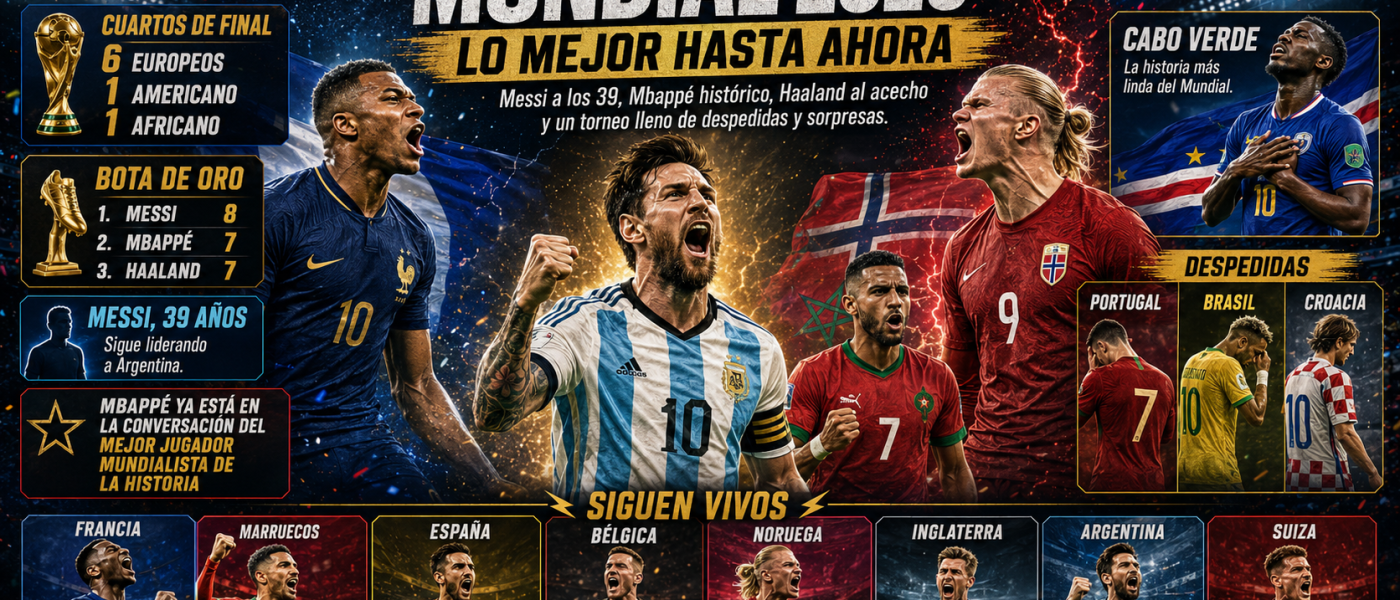
The 2026 World Cup has reached the quarterfinals with a brutal mix of drama, farewells, shocks, records and individual races that already feel historic. Eight teams remain: six from Europe, one from South America and one from Africa. Lionel Messi is still here at 39, leading Argentina and the Golden Boot race. Kylian Mbappé is building a serious case as the greatest World Cup player of all time. Erling Haaland has arrived on the biggest stage by knocking out Brazil. Morocco has stopped being a surprise and has become Africa’s great contender. And Cape Verde, even after elimination, may remain the most beautiful story of the expanded tournament.
This World Cup no longer feels like the one that began with 48 teams. The group stage created scale. The Round of 32 added chaos. The Round of 16 separated reputation from real survival. Now only eight teams remain, and the picture is clear: Europe has taken control, Africa still carries a powerful flag through Morocco, and South America is alive only because Argentina refused to fall.
Brazil are gone. Portugal are gone. Germany are gone. The Netherlands are gone. The United States, Mexico and Canada are gone. Colombia are gone. Egypt are gone with pride and frustration. Cape Verde are gone with global respect. And Messi is still standing.
The Eight Quarterfinalists at the 2026 World Cup
The quarterfinal field tells a strong story by itself. Six European teams, one South American team and one African team. No host nation. No South American giant beyond Argentina. No Concacaf team. No Asian team.
| Team | Confederation | How they arrive |
|---|---|---|
| France | Europe | Powerful, deep and built around Mbappé’s historic World Cup presence. |
| Spain | Europe | Control, patience and a surgical knockout win over Portugal. |
| Belgium | Europe | Renewed, aggressive and coming off a crushing 4-1 win over the United States. |
| Norway | Europe | Powered by Haaland after eliminating Brazil. |
| England | Europe | Surviving, dangerous and led by Kane and Bellingham. |
| Switzerland | Europe | Cold, organized and through on penalties against Colombia. |
| Argentina | South America | The defending champion, still driven by Messi after an epic comeback against Egypt. |
| Morocco | Africa | Africa’s great remaining hope, more stable and competitive than ever. |
The number matters: Europe holds six of the eight quarterfinal places. But the emotional heart of the tournament is not only European. It is Messi fighting time, Morocco carrying Africa’s dream, and Haaland opening a new World Cup era in real time.
Messi at 39: A World Cup Against Time
The most powerful image of the 2026 World Cup is still Messi.
Not because Argentina have played flawless football. Not because the defending champion has moved through the tournament easily. The opposite is true. Messi has reached the quarterfinals carrying a campaign full of pressure, decisive goals, emotional danger and moments that make his legend bigger precisely because he is no longer only playing against opponents. He is playing against the clock.
At 39, Messi leads the Golden Boot race and remains Argentina’s emotional center. He is not the Messi of constant explosion anymore. He is not the Messi of endless impossible sprints. This is a different Messi: more selective, more cerebral, more dramatic and more aware of every minute.
That is why this World Cup feels different.
Every time Messi touches the ball, the tournament seems to pause for a second. It is not only about what he can still do. It is about what he represents. He is the world champion defending his crown in the final stretch of a career that needs nothing, yet still wants more.
The Comeback Against Egypt Explains Everything
Argentina were 2-0 down against Egypt. Messi had missed a penalty. The champion was standing at the edge of elimination.
And still, Argentina came back.
Cristian Romero opened the door. Messi equalized. Enzo Fernández completed the comeback. Argentina won 3-2 and reached the quarterfinals. That night summed up Argentina’s tournament: suffering, character, tension, leadership and a competitive faith that refuses to die.
Messi did not have a perfect night. He had something larger: a night of resistance. He missed, came back, demanded the ball and ended up decisive.
At 39, that means more than any comfortable win.
Mbappé: The Best World Cup Player Ever Now Has a Real Case
The debate is no longer whether Kylian Mbappé is one of the great World Cup players. That discussion is outdated.
The real question is bigger: is Mbappé the greatest World Cup player of all time?
It sounds bold. But the argument is already there.
Mbappé won the World Cup in 2018 as a teenager and scored in the final. In 2022, he scored a hat trick in the wildest final of the modern era. In 2026, he has returned as France’s defining player, the central force of a team still advancing with authority.
His numbers have already moved him into historic territory. This is not promise anymore. This is sustained World Cup production across three tournaments, with goals in decisive matches, finals, knockout games and high-pressure moments.
There are players with longer careers. There are legends with older trophies. There are untouchable names. But if the criteria are pure World Cup impact, consistency, decisive goals, age and global dominance, Mbappé already has a case that cannot be ignored.
The World Cup Looks Like His Natural Stage
Some players shine for clubs and then feel the weight of the World Cup.
Mbappé seems to work the other way around. The World Cup makes him bigger.
He does not need to play perfectly for 90 minutes to feel inevitable. He can appear through a penalty, a sprint, a closed match or one sudden burst. France are not only Mbappé, but every opponent knows the game can break if he finds one meter.
That is what makes him special. At World Cups, Mbappé does not play like a guest star. He plays like the owner of the stage.
The Golden Boot Race: Messi, Mbappé and Haaland in a Historic Chase
The Golden Boot race has become one of the best individual stories of the tournament.
| Player | Team | Goals | What it means |
|---|---|---|---|
| Lionel Messi | Argentina | 8 | The emotional and scoring leader of the defending champion. |
| Kylian Mbappé | France | 7 | The most dominant World Cup player of this era. |
| Erling Haaland | Norway | 7 | The debutant who has already knocked out Brazil and changed Norway’s history. |
| Harry Kane | England | 6 | The striker keeping England alive in uncomfortable matches. |
Messi leads, but Mbappé and Haaland are only one goal behind. Kane is still close. And the most important part is that all four are still alive.
This is not an empty statistical race. It is a direct battle between massive narratives.
Messi is chasing one last impossible masterpiece at 39. Mbappé is trying to cement his historic reign. Haaland wants his first World Cup to become a foundational explosion. Kane wants England to stop living on promise and finally turn a generation into a title.
The Golden Boot will not be decided only by who scores more. It will be decided by who survives longer.
Haaland: The World Cup Debut That Has Already Changed Norway
Erling Haaland arrived at the World Cup with a massive question: could he transfer his club-level scoring brutality to the biggest tournament in football?
The answer has been violent.
Haaland did not just score. Haaland eliminated Brazil.
His double against the Seleção in the Round of 16 was one of the tournament’s defining nights. Norway did not reach the quarterfinals as a guest. Norway arrived after taking down a historic giant, with its star striker delivering the kind of performance that changes how an entire national team is perceived.
Norway are no longer “Haaland’s team” as a decorative label. They are serious, organized, dangerous and capable of keeping a match alive until Haaland can destroy it.
Haaland vs Kane: The Most Physical Quarterfinal
Norway vs England will be a battle of strikers, but also a battle of survival.
Haaland arrives on fire. Kane arrives as the player who keeps England alive when matches get ugly. The matchup brings power, aerial threat, pressure, fatigue and one central question: which team will handle the weight of the penalty area better?
If Haaland wins that duel, his World Cup can move from extraordinary to legendary.
Cape Verde: The Story That Justified the 48-Team World Cup
Cape Verde are not in the quarterfinals. And still, they are one of the most important stories of the 2026 World Cup.
The expanded tournament needed an example that proved more teams did not simply mean more matches. It needed a human, competitive and emotional story. Cape Verde delivered it.
They reached the knockout stage, faced Argentina, scored twice against the defending champion and pushed the match into extra time. They did not eliminate Messi. They did not advance. But they left with something many bigger teams failed to earn: global respect.
Cape Verde proved that the new format can open real doors. Not just to participate. To compete. To unsettle giants. To leave a memory.
Losing Can Still Build a Legend
The 3-2 defeat to Argentina in the Round of 32 did not feel like a normal loss.
It felt like a farewell with the stadium standing. Cape Verde came close to breaking a massive story. They did not quite do it, but they forced the champion to search the deepest part of itself.
Some teams win matches and disappear from memory. Cape Verde lost and stayed.
The Great Farewells of the 2026 World Cup
This tournament has also become a collection of powerful goodbyes.
Cristiano Ronaldo and Portugal’s Silence
Portugal went out against Spain in a painful, tight and symbolic 1-0 defeat.
Every Portugal elimination now brings the same question: was this Cristiano Ronaldo’s final World Cup? If it was, the ending could hardly have been crueler: against the Iberian rival, in the Round of 16, decided by a late goal and without one last explosion.
Ronaldo did not leave in a blowout or a minor match. He left in a high-tension knockout game, with Portugal still alive until the final stretch. That makes it hurt more.
Neymar, Brazil and Another Wound That Refuses to Heal
Brazil went out earlier than expected again. This time against Norway, with Haaland as the executioner.
The image of Neymar emotionally broken by another World Cup elimination matters because Brazil did not only lose a match. Brazil lost another chance to reconcile its talent with its recent World Cup history.
Brazil still have players. Brazil still have a heavy shirt. Brazil still have nights of control. But in decisive moments, something is still missing.
Modrić and the End of a Croatian Era
Croatia were eliminated by Portugal in the Round of 32, leaving another farewell hanging in the air: Luka Modrić.
For years, Croatia turned experience, suffering and penalties into survival. This time, it was not enough. If this was Modrić’s final World Cup, he left the way he played so many great nights: competing to the limit.
The Hosts Are Gone Too
Canada, Mexico and the United States are all out.
All three had moments. All three moved the tournament emotionally. None reached the quarterfinals. That changes the atmosphere of the World Cup. The party continues in North America, but no host nation remains inside the bracket.
Mexico left with the pain of the Azteca. The United States left after a brutal 4-1 defeat to Belgium. Canada left after running into a Morocco side that was simply superior. The World Cup no longer has hosts alive, but it still has stories everywhere.
The Biggest Shocks So Far
Germany Out Against Paraguay
Germany’s elimination in the Round of 32 was one of the first true earthquakes. Paraguay dragged the match to penalties and knocked them out. For a team with Germany’s weight, falling before the Round of 16 is a massive wound.
The Netherlands Eliminated by Morocco
Morocco proved again that this is not a one-tournament miracle. They eliminated the Netherlands on penalties and then crushed Canada. They are not a surprise anymore. They are structure, belief and competitive memory.
Brazil Eliminated by Norway
The loudest shock of the Round of 16. Brazil out. Haaland celebrating. Norway in the quarterfinals. A result that changed how the bracket is now understood.
Argentina Surviving Egypt
The defending champion was 2-0 down and came back. That kind of match can change a tournament. Not because Argentina solved all its problems, but because it remembered something even more important: it still knows how to suffer and win.
The Quarterfinals: Four Matches, Four Worlds
| Quarterfinal | Main storyline |
|---|---|
| France vs Morocco | Mbappé against Africa’s great flagbearer. Recent memory, tension and Moroccan structure. |
| Spain vs Belgium | Spanish control against Belgian punishment. Possession against efficiency. |
| Norway vs England | Haaland against Kane. Power, penalty-box pressure and England’s historic burden. |
| Argentina vs Switzerland | Messi and the defending champion against the coldest, most organized and hardest team to break. |
The quarterfinals are perfect from a storytelling point of view. There is no minor match. Every tie has a different kind of tension.
France vs Morocco carries memory, sporting politics, cultural charge and elite football. Spain vs Belgium is a tactical argument between control and impact. Norway vs England is a striker war and a mental test. Argentina vs Switzerland is the emotional champion against a team that turns every match into an exam of patience.
The World Cup of Individual Names
This World Cup has strong teams, but it has been dominated by individual names.
Messi. Mbappé. Haaland. Kane. Bellingham. De Ketelaere. Ounahi. Enzo. Romero. Salah. Ronaldo. Neymar. Modrić.
Some are still here. Others have already left. But all of them have marked the story.
What makes this edition special is that generations are colliding directly. Messi is resisting. Ronaldo may be saying goodbye. Neymar is trapped again in World Cup frustration. Mbappé is claiming the historic throne. Haaland is entering the World Cup as if it had always belonged to him. Bellingham and De Ketelaere are pushing Europe’s renewal.
It is a World Cup of transition, but not a World Cup of emptiness. The legends have not fully left. The new kings have already arrived.
The Big Question: Are We Watching the Definitive Change of Era?
The 2026 World Cup may be remembered as the tournament where two things happened at the same time.
First, Messi stretched history beyond logic. At 39, he is still scoring, leading and carrying the defending champion.
Second, Mbappé and Haaland turned the future into the present. They are no longer promises, successors or players expected to dominate someday. They dominate now.
That makes the Golden Boot race symbolically massive. If Messi wins it, it becomes one last masterpiece against time. If Mbappé wins it, it becomes another chapter in his case as the greatest World Cup player ever. If Haaland wins it, it becomes the birth of a new global force in the biggest competition in football.
Any of those endings would change the meaning of the tournament.
Final Take: The 2026 World Cup Already Has Its Own Memory
The 2026 World Cup does not need to wait for the final to be remembered.
It already has Cape Verde’s story. It already has Germany’s collapse. It already has Morocco back among the serious contenders. It already has Haaland eliminating Brazil. It already has the possible farewell of Ronaldo and Modrić. It already has Neymar facing another World Cup exit. It already has all three host nations out. It already has Messi, at 39, leading the Golden Boot race. It already has Mbappé building a historic case that football will debate for decades.
And the quarterfinals, semifinals and final are still ahead.
Eight teams remain. Six from Europe. One from South America. One from Africa.
Messi, Mbappé and Haaland are still in the same race.
This World Cup started big because of its format.
It became enormous because of its stories.